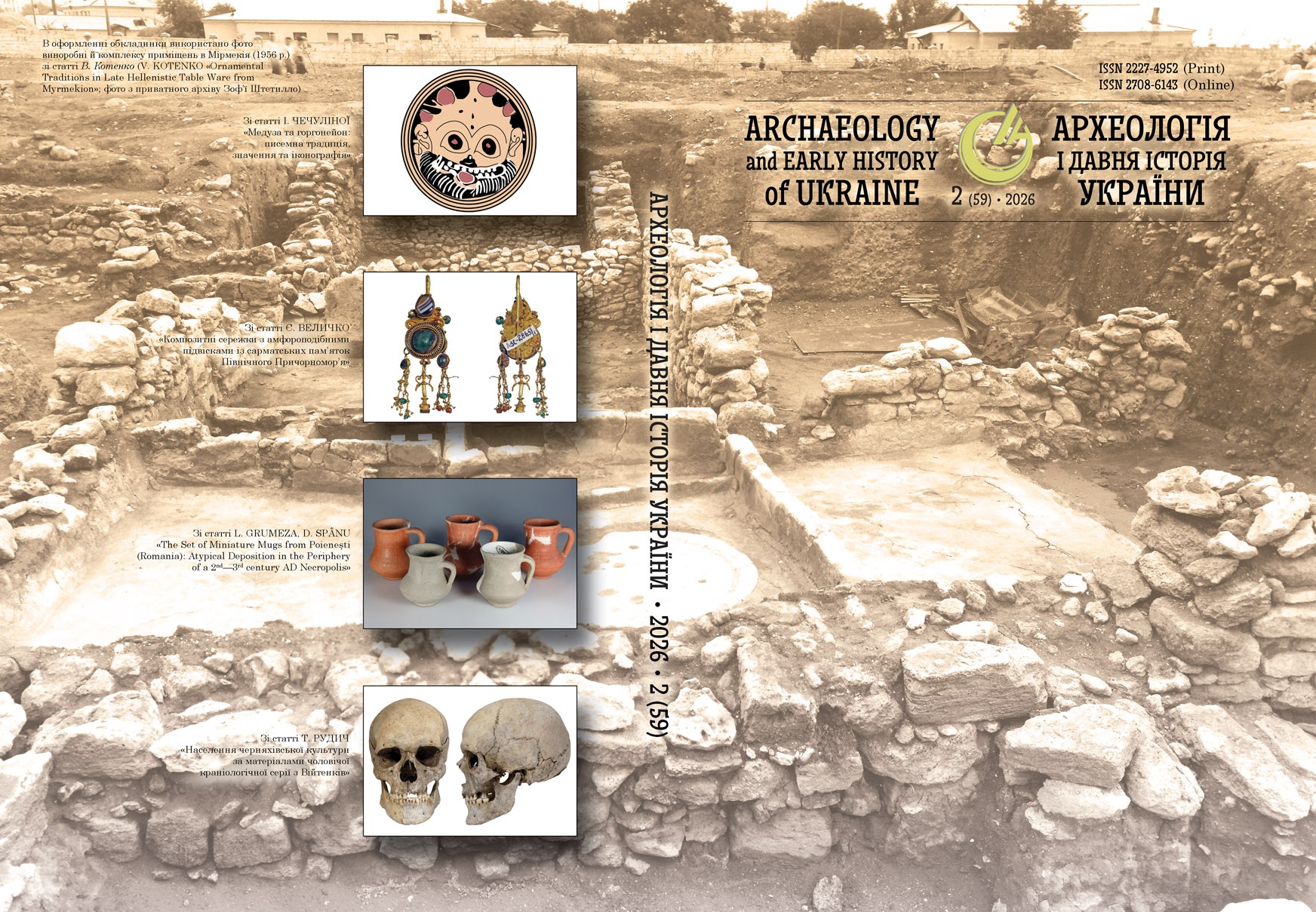
THE POPULATION OF THE CHERNYAKHIV CULTURE. A CASE STUDY OF THE MALE CRANIOLOGICAL SERIES FROM VIYTENKI
DOI:
https://doi.org/10.37445/adiu.2026.02.08Keywords:
Chernyakhiv—Sвntana de Mureş culture, Roman period, anthropology, craniology.Abstract
Anthropological material comes from excavations of a burial ground near the village of Viytenki (Valkiv district, Kharkiv region) in the Dnieper-Donetsk watershed. The site was studied by the German-Slavic Archaeological Expedition of the V. N. Karazin Kharkiv National University (headed by Dr. Liubychev) and the Eurasian Department of the German Archaeological Institute. The male series is characterized by a long, medium-wide skull on average. In terms of skull shape, the series is on average on the border between mesocrania and dolichocrania. The height of the skull belongs to the category of tall, but with a tendency to medium sizes. The face is medium wide at the upper level, at the level of the diameter of the cheekbones and the zygomaxillary levels. The height of the face is average. According to the upper facial index, the face belongs to the mezen category. It is worth noting that in the male series, skulls with a narrow and wide face are recorded. The horizontal profiling of the face is sharp both at the upper and middle levels.The orbits have a small width, but on the border with the average. Their height is small. The orbits are mesoconchic according to the orbital index. The nose is medium high, narrow, according to the index, the nose is mesorhinal. The nasal bones protrude well. The bridge of the nose is high. The male series from Viytenki fits into the range of variations of the groups of the Chernyakhiv culture. When comparing the male series from Viytenki with the craniological material of Chernyakhiv culture of the Left Bank of Dnieper, the male sample of skulls from the Boromlia burial ground is found to be the most morphologically and statistically similar to it, the group from Uspenka gravitates to a lesser extent, although the latter is more gracile. The series from Viytenki is included in the group of groups characterized by large skull sizes and sharp horizontal profiling. These series have anthropological analogies mainly in the Baltic region. Among the series of Eastern Europe Viytenki is morphologically and statistically close to the series of the 2nd—5th centuries from the territory of Lithuania. Viytenki and Havrylivka being included into comparative analysis of the groups of Central, Northern and Southern Europe demonstrate the proximity to the Welbark culture burial ground Grudek and the collective series of the Przeworsk culture of Poland. The series from Viytenki and Havrylivka, being included to the analysis of chronologically later material, demonstrate statistical similarity with the burial grounds of Sweden of the 1st millennium AD, the Visigothic burial grounds of Castile of the 6th—8th centuries, and the collective series of the Przeworsk culture of Poland.
References
Alekseev, V. P. 1966. Osteometriia. Metodika antropologicheskih issledovanii. Moskva: Nauka.
Alekseev, V. P., Debez, G. F. 1964. Kraniometriia. Metodika antropologicheskih issledovanii. Moskva: Nauka.
Balabanova, M. A. 1999. Antropologiia sarmatskikh pogrebalnykh pamiatnikov nizhnego Povolzhia 4—3 vv. do n. e. Nizhnevolzhskii arkheologicheskii vestnik, 2, s. 54-72.
Balabanova, M. A. 2000. Antropologiia drevnego naseleniia Iuzhnogo Priuralia i Nizhnego Povolzhia. Rannii zheleznyi vek. Moskva: Nauka.
Balabanova, M. A. 2003. Rekonstruktsiia sotsialnoi organizatsii pozdnikh sarmatov po antropologicheskim dannym. Nizhnevolzhskii arkheologicheskii vestnik, 6, s. 66-88.
Batieva, E. F. 2011. Naselenie Nizhnego Dona v IX v. do n. e. — IV v. n. e. (paleoantropologicheskoe issledovanie). Rostov-na-Donu: IUNTS RAN.
Velikanova, M. S. 1975. Paleoantropologiia Prutsko-Dnestrovskogo mezhdurechia. Moskva: Nauka.
Volfram, H. 2003. Goty: Ot istokov do serediny VI veka (opyt istoricheskoi etnografii). Sankt-Piterburg: Iuventa.
Gerasimova, M. M., Rud, N. M., Iablonskii, L. T. 1987. Antropologiia antichnogo i srednevekovogo naseleniia Vostochnoi Evropy. Moskva: Nauka.
Gravere, R. U. 1999. Odontologicheskii aspekt etnogeneza i etnicheskoi istorii vostochnoslavianskikh narodov. In: Alekseeva, T. I. (ed.). Vostochnye slaviane. Antropologiia i etnicheskaia istoriia. Moskva: Nauchnyi mir, s. 205-219.
Debetz, G. F. 1948. Paleoantropologiia SSSR. Trudy Instituta etnografii im. N. N. Mikluhi-Maklaia: Novaia seriia, 4. Moskva; Leningrad: AN SSSR.
Efimova, S. G. 1999. Naselenie Vostochnoi Evropy v epokhu zheleza i pozdnerimskoe vremia. In: Alekseeva, T. I. (red.). Vostochnye slaviane. Antropologiia i etnicheskaia istoriia. Moskva: Nauchnyi mir, s. 279-306.
Zinevych, H. P. 1971. Do antropolohii mogilnika s. Zavetne v Krymu. Manerialy z antropolohii Ukrainy, 5, s. 111-121.
Kozak, O. D. 2019 Patolohichni oznaky na skeleti yak markery mihratsij. Arkheolohiia, 1, s. 14-27.
Konduktorova, T. S. 1956. Materialy po paleoantropologii Ukrainy. Trudy Instituta Etnografii, 33, s. 57-91.
Konduktorova, T. S. 1958 Paleoantropologicheskii material iz mogilnika polei pogrebalnyh urn Khersonskoi oblasti. Sovetskaia arheologiia, 2, s. 69-79.
Konduktorova, T. S. 1964. Naselennia Neapolia Skifskoho za antropolohichnymy danymy. Materialy z antropolohii Ukrainy, 3, s. 32-71.
Konduktorova, T. S. 1972. Antropologiia drevnego naseleniia Ukrainy (I tys. do n. e. — serediny I tys. n. e.). Moskva: MGU.
Konduktorova, T. S. 1979a. Antropologicheskie materialy cherniakhovskoi kultury Ukrainy. In: Symonovich, E. A. Mogilniki cherniakhovskoi kultury. Moskva: Nauka, s. 163-204.
Konduktorova, T. S. 1979b. Fizicheskii tip liudei Nizhnego Podneprovia na rubezhe nashei ery (po materialam mogilnika Nikolaevka-Kozatskoe). Moskva: Nauka.
Kruts, S. I. 1993. Sarmaty Tavrii po antropologicheskim danniam. In: Simonenko, A. V. Sarmaty Tavrii. Kiev: Naukova dumka, s. 131-119.
Lyubychev, M. V. 2019. Rannyaya istoriya dnepro-doneczkoj lesostepi I—V vekov. 1, 2. Ostrogotika-seria, 2. Kharkov: Estet print.
Magomedov, B. V. 2001. Cherniakhovskaia kultura. Problema etnosa. Lublin: UMCS.
Nazarova, T. A. 2014. Naselenie Khersonesa v pervye veka novo ery. Istorychna antropolohiia ta bioarkheolohiia Ukrainy, 1, s. 35-48.
Nazarovа, T., Rudych, T. 2024. Naselennia Olvіi pershykh stolіt n. e. za materіalamy antropologii. Arkheologіia і davnia іstorіia Ukrainy, 4 (53), s. 163-177. https://doi.org/10.37445/adiu.2024.04.11
Pokas, P. M. 2000. Novye antropologicheskie materialy k probleme differentsiatsii cherniakhovskoi kultury In: Alekseeva, T. I. (red.). Narody Rossii: ot proshlogo k sovremennosti. Antropologiia. 2. Moskva: Staryi Sad, s. 260-273.
Rudich, T. A. 2000. Naselenie cherniakhovskoi kultury Srednego Podneprovia po materialam antropologii. Stratum plus, 4, s. 278-288.
Rudych, T. O. 2003. Antropolohichnyi sklad naselennia cherniakhivskoi kultury Pivnichnoho Prychornomor’ia. Arkheolohiia, 4, s. 19-32.
Rudych, T. O. 2004а. Antropolohichnyi sklad naselennia cherniakhivskoho mohylnyka Cherneliv-Ruskyi. Arkheolohichni vidkryttia v Ukraini 2002—2003 rr., s. 388-397.
Rudych, T. O. 2004b. Antropolohichnyi sklad naselennia cherniakhivskoi kultury Zakhidnoi Ukrainy. Arkheolohiia, 3, s. 388-397.
Rudych, T. O. 2007. Antropolohichnyi sklad naselennia cherniakhivskoi kultury. Pytannia yoho pokhodzhennia ta henetychni zv’iazky. Zapysky naukovoho tovarystva im. T. H. Shevchenka, CCLIII, s. 386-413.
Rudych, T. O. 2014a. Antropolohichnyi material z mohylnyka cherniakhvskoi kultury Lisovi Hrynivtsi. Arheolohiia, 3, s. 79-91.
Rudych, T. O. 2014b Naselennia Serednoho Podniprov’ia I—II tysiacholittia za materialamy antropolohii. Kyiv: IA NAN Ukrainy.
Rudych, T. O. 2021. Naselennia cherniakhivskoi kultury, pokhovane na mohylnyku bilia s. Velyka Buhaivka, za materialamy kraniolohii. Arkheolohiia i davnia istoriia Ukrainy, 3 (40), s. 293-303. https://doi.org/10.37445/adiu.2021.03.19
Rudych, T. O. 2022. Naselennia cherniakhivskoi kultury za materialamy mohylnyka Cherkasy-Tsentr (kraniolohichnyi aspekt) Arkheolohiia, 1, s. 86-100. https://doi.org/10.15407/arheologia2022.01.086
Segeda, S. P., Diachenko, V. D. 1984. Antropologicheskii material iz cherniakhovskogo mogilnika u s. Kholmskoe. In: Gudkova, A. V., Fokiev, M. M. Zemledeltsy i kochevniki v nizoviakh Dunaia 1—4 vv. n. e. Kiev: Naukova dumka, s. 94-105.
Sokolova K. F. 1963. Antropolohichni materialy mohylnykiv Inkermanskoi dolyny Arkheolohichni pam’iatky URSR, 13, s. 124-159.
Gerling, C., Kozak, O., Liubichev, M., Rudich, T., Schultze, E. 2025. Investigating the origins of the Cherniakhiv community at Voitenki, East Ukraine, through strontium isotope analysis. Praehistorische Zeitschrift. https://doi.org/10.1515/pz-2024-2048
Kozak-Zychman, W. 1996. Charakterystyka antropologsczna ludnoszczny z mlodszego okresu rymskiego. Lublin: UMCS.
Martin, R. 1928. Lehrbuch der Anthropologie. Jena: Fisher.
Mikic, Z. 1988. Antropoloska struktura stanovnistva Srbije. Etnoantropoloski problemi — monografije, 4. Beograd.
Piontek, J., Iwanek, B., Segeda, S. 2008. Antropologia o pochodzeniu Slowian. Monografie IA UAM, 12. Poznan.
Rosing, F., Schwidetzky, I. 1977. Vergieichend — statistische Untersuchugen zur Antropologie der Fruchen Mittelalters (500—1000 n. d. z.). Homo, 28, 4, S. 65-115.
Rudic, T. 2017. Antropologische Materialien aus der Černjachov-Nekropole Nagornoe 2. In: Gudkova, A., Schultze, E. Gräberfeld und Siedlung Nagornoe 2. Archäologie in Eurasien, 35, S. 145-163.
Schwidetzky, I. Rösing, F. 1975. Vergleichend-statistische Untersuchungen zur Anthropologie der Römerzeit (0—500). Homo, 26, 4, S. 193-218.