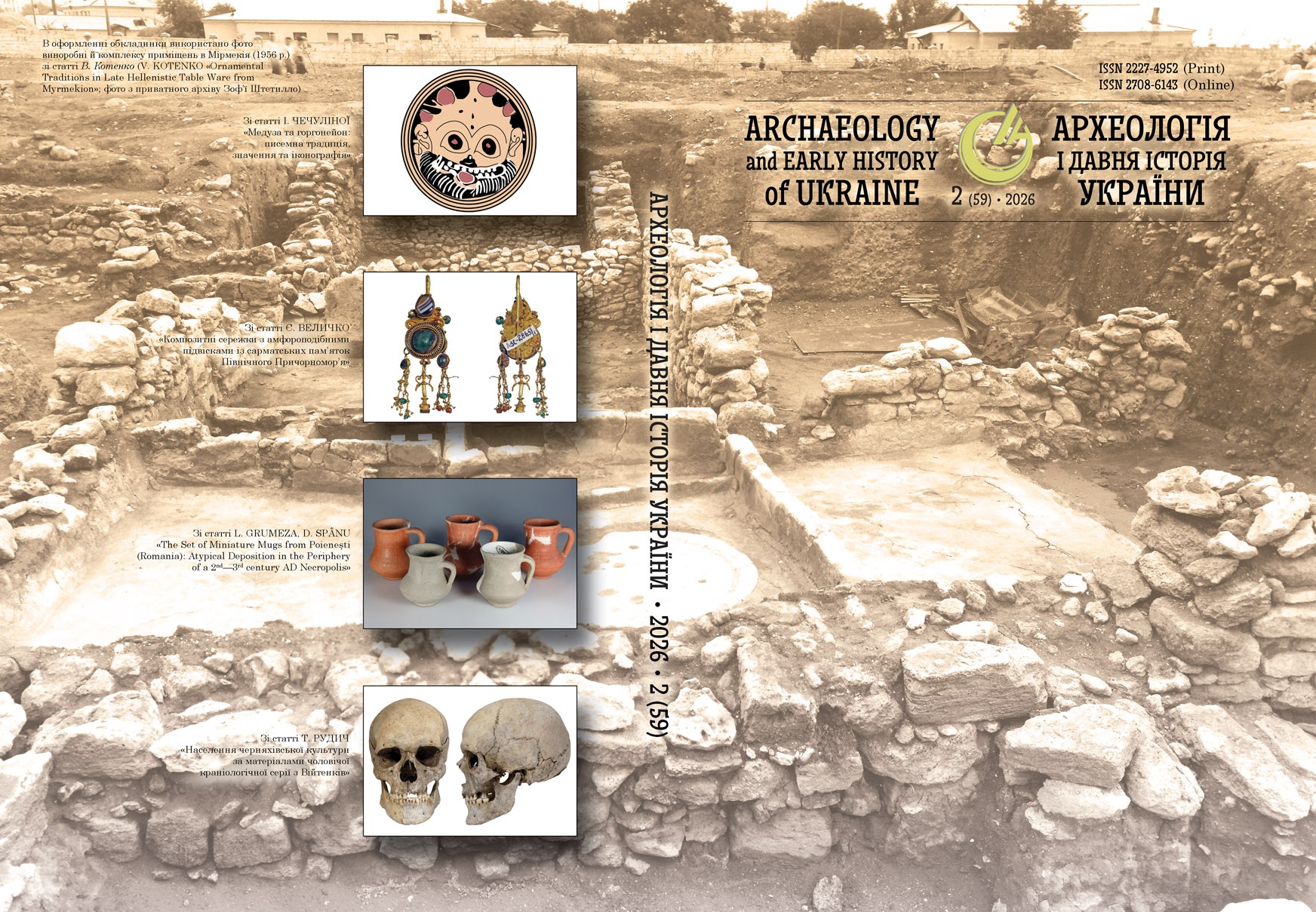
MEDUSA AND THE GORGONEION: WRITTEN TRADITION, SIGNIFICANCE AND ICONOGRAPHY
DOI:
https://doi.org/10.37445/adiu.2026.02.12Keywords:
Medusa, Gorgoneion, ancient Greek art, Northern Black sea region, iconography.Abstract
The author examines the image of Medusa and the Gorgoneion in ancient culture through the lens of written sources, interpretations of its meaning, and the development of its iconography. The aim of the study is to summarize the main approaches to the interpretation of the Gorgon’s image and to analyze the evolution of its depiction in ancient Greek art. Based on ancient literary sources (Hesiod, Homer, Pindar, Apollodorus, Ovid and others), the mythological context of the formation of Medusa’s image is outlined. Various interpretations of the meaning of the Gorgoneion are considered, among which the most widespread is the apotropaic function aimed at warding off danger and evil. Alternative interpretations that associate this image with chthonic and natural forces, fertility cults, or the symbolism of life and death are also analyzed. Particular attention is paid to the use of the Gorgoneion in ancient art and material culture, including architectural elements, armor, coins, mosaics, and especially ceramics associated with the symposium. In addition, the study is focused on the main aspects of the use of the Gorgoneion in the Northern Black Sea region. Special emphasis is placed on its application on ceramic vessels, bronze objects, and architectural details, as well as its presence in funerary, sacred, and everyday contexts. This demonstrates the multifunctionality of the image and its wide range of uses in different spheres of life. The author also examines the development of the Gorgon’s iconography from archaic monstrous forms to more humanized and even attractive depictions of the Classical and later periods. The traditional typology of Gorgon representations is analyzed, and its limitations are outlined. It is shown that different iconographic variants could coexist within the same chronological period. Thus, the image of Medusa and the Gorgoneion in ancient Greek art is characterized by considerable variability and semantic complexity, combining apotropaic, religious, and symbolic functions. The article also provides an expanded theoretical framework for the further publication and analysis of Gorgoneion medallions on cups from Olbia and Borysthenes.
References
Alekseev, V. P. 1999. O monetnom iskusstve Olvii klassicheskogo i ranneellinisticheskogo vremeni. Stratum plus, 6, s. 74-83.
Alekseev, V. P. 2004. Novye materialy k izucheniyu kultury antichnykh gorodov Severnogo Prichernomorya (Tira — Nikoniĭ — Ol’viya — Khersones). Vestnik drevney istorii, 3, s. 74-75.
Anokhin, V. A. 2011. Monety antichnykh gorodov Severo-Zapadnogo Prichernomoria. Kiev: Naukova dumka.
Bujskikh, A. V. 2013. Novyye nakhodki chash Siana iz Olvii. Arkheologicheskiye vesti, 17, s. 105-114.
Hesiod. 2018. Pokhodzhennia bohiv. Roboty i dni. Shchyt Herakla / per. Andrii Sodomora. Lviv: Apriori.
Gorbunova, K. S. 1982. Atticheskaya chernofigurnaya keramika iz raskopok 1962-1971 gg. na uchastke «G» o. Berezan. In: Boriskovskaya, S. P. (red.). Khudozhestvennyye izdeliya antichnykh masterov. Moskva: Iskusstvo, s. 36-
49.
Duvakin, E. N. 2009. Golova Meduzy Gorgony: semantika apotropeia. Vestnik RGGU: Literaturovedenie. Iazykoznanie. Kulturologiia, 9, s. 97-104.
Karyshkovskii, P. O. 1988. Monety Olvii. Kiev: Naukova dumka.
Karyshkovskii, P. O. 2003. Monetnoe delo i denezhnoe obrashchenie Olvii (VI v. do n. e. — IV v. n. e.). Odessa: A. S. Fridman.
Kopeykina, L. V. 1986. Raspisnaya keramika arkhaicheskogo vremeni iz antichnykh poseleniy Nizhnego Pobuzhia i Podneprovia kak istochnik dlya izucheniya torgovykh i kulturnykh svyazey. Arkheologicheskiy sbornik Gosudarstvennogo Ermitazha, 27, s. 27-47.
Kryzhitskii, S. D., Leipunskaia, N. A. 2014. Zhilye doma tsentralnogo kvartala v raione agory. In: Zinko, V. N. (red.). Zhilye doma Tsentralnogo kvartala Olvii. Materialy po arkheologii, istorii i etnografii Tavrii, 13. Simferopol; Kerch: Tavricheskii natsionalnyi universitet im. V. I. Vernadskogo, s. 6-142.
Kryzhitskii, S. D., Rusiaeva, A. S., Nazarchuk, V. I. 2006. Arkhitekturnaia terrakota VI—V vv. do n. e. In: Aibabin, A. I. (red.). Drevneyshii temenos Olvii Pontiyskoi. Materialy po arheologii, istorii i etnografii Tavrii, 2. Simferopol: Demetra, s. 100-114.
Kuznetsova, T. M. 2002. Zerkala Skifii VI—III veka do n. e. 1. Moskva: Indrik.
Mozolevskyi, B. M. 1979. Tovsta Mohyla. Kyiv: Naukova dumka.
Ostroverkhov, A. S., Okhotnykov, S. B. 2007. Ostriv Akhilla u Hostynnomu mori. In: Smolii, V. A. (red.). Nadchornomoria u IX st. do n. e. — na pochatku ХІХ st.: studii z istorii ta arkheolohii. 1. Kyiv: Instytut istorii Ukrainy NAN Ukrainy, s. 26-59.
Rakhno, K. 2019. Horhona v budivelnii keramitsi antychnosti: vytoky ta semantyka apotropeiu. Arkheolohichna keramolohiia, 2 (2), s. 93-119.
Rusiaeva, A. S. 2006. Graffiti. In: Aibabin, A. I. (red.). Drevneyshii temenos Olvii Pontiyskoi. Materialy po arheologii, istorii i etnografii Tavrii, 2. Simferopol: Demetra, s. 118-134.
Rusyaeva, A. S., Nazarchuk, V. I. 2006. Atticheskaia keramika. In: Aibabin, A. I. (red.). Drevneyshii temenos Olvii Pontiyskoi. Materialy po arheologii, istorii i etnografii Tavrii, 2. Simferopol: Demetra, p. 169-177.
Rusiaieva, A. S., Sazonova, N. H. 1986. Keramichnyi kompleks arkhaichnoho chasu iz Olvii. Arkheolohiia, 55, s. 48-63.
Skrzhinskaia, M. V. 2010. Kulturnye traditsii Ellady v antichnykh gosudarstvakh Severnogo Prichernomoria. Kiev: Institut istorii Ukrainy NAN Ukrainy.
Skudnova, V. M. 1988. Arkhaicheskii nekropol Olvii. Leningrad: Iskusstvo.
Shaub, I. Iu. 1999. Kult Velikoi Bogini u mestnogo naseleniia Severnogo Prichernomoria. Stratum plus, 3, s. 207-223.
Shaub, I. Iu. 2021. Gorgona v religii meotov. Materialy po arkheologii i istorii antichnogo i srednevekovogo Prichernomoria, 12, s. 701-714.
Banou, E. S., Bournias, L. C. 2014. Kerameikos. Vaduz: John S. Latsis Public Benefit Foundation.
Beazley, J. D. 1986. The Development of Attic Black-Figure. Berkeley: University of California.
Besig, H. 1937. Gorgo und Gorgoneion. In der Archaischen Griechischen Kunst. Berlin: H. Markert.
Boardman, J. 1989. Greek Art. London: Thames & Hudson.
Bujskikh, A. 2025. Architectural Terracotta from Olbia Pontica. Kyiv: Institute of Archaeology NAS of Ukraine.
Bundrick, S. D. 2015. Athenian Eye Cups in Context. American Journal of Archaeology, 119, 3, p. 295-341.
Finlayson, C., Gutierrez Lopez, J. M., Reinoso del Rio, M. C., Saez Romero, A. M., Giles Guzman, F., Finlayson, G., Giles Pacheco, F., Abulafia, D., Finlayson, S., Jennings, R. P., Rodriguez Vidal, J. et al. 2021. Where myth and archaeology meet: Discovering the Gorgon Medusa’s Lair. PLoS ONE, 16, 4, e0249606. DOI: 10.1371/journal.pone.0249606
Floren, J. 1977. Studien zur Typologie des Gorgoneion. Munster: Aschendorff.
Frothingham, A. L. 1911. Medusa, Apollo, and the Great Mother. American Journal of Archaeology, 15, 3, p. 349-377.
Frothingham, A. L. 1915. Medusa II. The Vegetation Gorgoneion. American Journal of Archaeology, 19, 1, p. 13-23.
Furtwängler, A. 1886—1890. Die Gorgonen in der Kunst. In: Roscher, W. (ed.). Lexikon der Griechischen und Römischen Mythologie. 1 (2). Leipzig: Teubner, p. 1701-1728.
Glennon, M. 2017. Medusa in Ancient Greek Art. In: (without ed.). Heilbrunn Timeline of Art History. New York: The Metropolitan Museum of Art. Available at: https://www.metmuseum.org/ru/essays/medusa-in-ancient-greek-art (30.03.2026).
Graves, R. 1955. The Greek Myths. London: Penguin.
Hartswick, J. H. 1993. The Gorgoneion on the Aigis of Athena: Genesis, Suppression and Survival. Revue Archéologique, Nouvelle Série, 2, p. 269-292.
Hedreen, G. 2007. Involved Spectatorship in Archaic Greek Art. Art History, 30, 2, p. 217-246.
Higgins, R. A. 1979. Catalogue of the Terracottas. British Museum, Department of Greek and Roman Antiquities. London: British Museum.
Hildburgh, W. L. 1947. Apotropaism in Greek Vase-Paintings (Continued). Folklore, 58, 1, p. 208-225.
Hopkins, C. 1934. Assyrian Elements in the Perseus — Gorgon Story. American Journal of Archaeology, 38, 3, p. 341-358.
Howe, T. P. 1954. The Origin and Function of the Gorgon-Head. American Journal of Archaeology, 58, 3, p. 209-221.
Karoglou, K. 2018. Dangerous Beauty: Medusa in Classical Art. The Metropolitan Museum of Art Bulletin, 75, 3, p. 1-47.
Kästner, V. 1989. Gorgoneionantefixe aus Süditalien. Forschungen und Berichte, 27, p. 115-128.
Lazarou, A. 2019. Golden Gorgon-Medousa Artwork In Ancient Hellenic World. Scientific Culture, 5, 1, p. 1-14.
Lazarou, A. 2022. Gorgoneion and Gorgon-Medusa: A Critical Research Review. Journal of Ancient History and Archaeology, 9, 1, p. 47-62.
Lazarou, A. 2024. The myth of Gorgo/Medusa in ancient written sources. Proceedings of the European Academy of Sciences & Arts, 3, p. 55-76.
Lazarou, A. 2025. Metamorphoses of the Gorgo-Medusa from Archaic Greece to Late Antiquity. British Archaeological Reports International Series, 3223. Oxford: British Archaeological Reports.
LIMC IV.1: Krauskopf, I. 1988. Gorgo, Gorgones. In: Balty, J., Berger, E., Boardman, J., Bruneau, P., Canciani, F., Kahil, K., Lambrinoudakis, V., Simon, E. (eds.). Lexicon Iconographicum Mythologiae Classicae. IV (1): Eros-Herakles. Zurich-Munich: Artemis, p. 285-330.
Lopez, G. R. A. 2025. The Gorgoneion and the Evil Eye: Cultural Importance and Acceptance of Apotropaic Iconography in the Ancient Greco-Roman World. Athens Journal of Mediterranean Studies, 12, 1, p. 63-102. https://doi.org/10.30958/ajms.12-1-4
Mack, R. 2002. Facing Down Medusa (An aetiology of the gaze). Art History, 25, 5, p. 571-604.
Mujkanovic, E. 2020. Gorgon motifs on Archaic Greek coins. Thesis, Uppsala Universitet, Institutionen för arkeologi och antik historia. Available at: http://urn.kb.se/resolve?urn=urn:nbn:se:uu:diva-418134 (18.03.2026).
Nazarchuk, V. I. 2010. Black-figured pottery. In: Leypunskaya, N. A., Bilde, P. G., Højte, J. M., Krapivina, V. V. (eds.). The Lower City of Olbia (Sector NGS) in the 6th Century BC to the 4th Century AD. Aаrchus: Aarchus Univerity, p. 187-
196.
Nicholls, R. 1970. Architectural Terracotta Sculpture from the Athenian Agora. Hesperia, 39, 2, p. 115-138.
Potts, A. M. 1982 (2014). The World’s Eye, folklore essay. Lexington: University Press of Kentucky.
Prentice, A. 2007. Athenian Eyecups of the Late Archaic Period. Electronic Melbourne Art Journal, 2. Available at: https://www.index-journal.org/emaj/issue-2/an-interpretation-of-two-archaic-athenian-eyecups-by-andrew-prentice (18.03.2026).
Reeder, E. D. (ed.). 1995. Pandora: Women in Classical Greece. Princeton: Princeton University.
Rolle, R., Mueller-Wille, M., Schietzel, K. (eds.). 1991. Gold der Steppe. Archäologie der Ukraine. Schleswig: Archäologisches Landesmuseum.
Smith, T. J. 2013. Athenian Pottery from Berezan at the Hermitage-Revisited. In: Tsetskhladze, G. R. (eds.). The Bosporus: Gateway between the Ancient West and East (1st Millennium BC—5th Century AD). Proceedings of the Fourth International Congress on Black Sea Antiquities. Oxford: Archaepress, p. 347-354.
Spathi, M. 2024. The Interpretation of Clay Gorgoneion — Roundels in Sacral Contexts: Evidence from the Sanctuary of Artemis Limnatis at Ancient Messene. In: Spathi, M. G., Chidiroglou, M. and Wallensten, J. (eds.). Apotropaia and Phylakteria. Oxford: Archaeopress, p. 85-99.
Topal, D., Grumeza, L. 2025. The Medusa-Gorgon of Mereni (Republic of Moldova) and her Myth. Journal of Ancient History and Archaeology, 12, 4, p. 126-142.
Topper, K. 2007. Perseus, the Maiden Medusa, and the Imagery of Abduction. Hesperia: The Journal of the American School of Classical Studies at Athens, 76, 1, p. 73-105.
Wilk, S. R. 2000. Medusa: Solving the Mystery of the Gorgon. Oxford; New York: Oxford University.
Wilson, L. M. 1920. Contributions of Greek Art to the Medusa Myth. American Journal of Archaeology, XXIV, 3, p. 232-240.
Wohl, B. 1996. A Campanian Gorgon Antefix. The J. Paul Getty Museum Journal, 24, p. 13-20.
Zolotnikova, O. A. 2016. A hideous monster or a beautiful maiden?: Did the Western Greeks alter the concept of Gorgon?. In: Reid, H. L., Tanasi, D. (eds.). Philosopher Kings and Tragic Heroes: Essays on Images and Ideas from Western Greece. 1. Sioux: Parnassos Press — Fonte Aretusa, p. 353-370.